|
|
アラン・ウエスト
日本画/屏風、掛け軸 |
■ 作品について
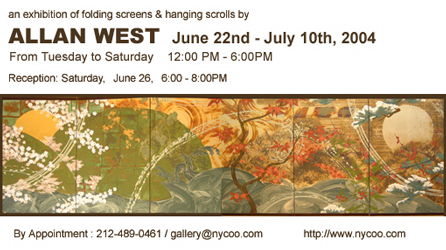
The energies and vitality of nature, though unseen, are nevertheless real. I see it as my job to
make them visibly tangible. I see elements of nature as metaphors for man unaffected by his
chaotic environment. I have chosen traditional Japanese materials because of their inherently
natural origins, their fluid responsiveness to my brush. I found the Japanese folding screen
painting (byobu) format with its and because of three dimensional surface to be ideal for creating
the kind of depth I had been aiming for. The world within the painting seems to continue on beyond
the boundaries of the viewer and the light change. I believe art should be experienced viscerally.
These are not landscapes we peer into as we would a window. These are large scale works that place
the viewer inside the painting. A painting that fills ones visual field. A painting in which one
senses an animate presence in the work.
■ アトリエ
In the middle of traditional old town Tokyo surrounded by Buddhist temples, you can find
his Studio. What was once an auto body garage is now a glass fronted gallery/studio.
It has received the Taito-ku award for high visibility atelier workshops. It has received
nearly monthly reporting from the media, and is considered a neighborhood landmark.
His purpose is to open up the process and development of a painting to public view.
In the mountains by the sea, at Japan’s oldest hot spring resort, stands what was until 1993,
a geisha academy and registry (kemban). The traditional auditorium and lesson rooms still
contain all of the various equipments for training geisha in the traditional arts. He paints
most of his larger works there, and he has found it to be the best environment to truly focus.
It has been the stage for some of his most major breakthroughs. Three times yearly He hold an
artist retreat here. He believes its history has helped to people it with very condescending muses.
|
■ アラン・ウエスト プロフィール
1962Born in United States. Moved to Washington D.C.
1978Studied at Corcoran School of Art.
Awarded National Merit Scholar Award for Art
1981Entered Carnegie-Mellon University College of Fine Arts
1982-84First stay in Japan (Shikoku)
1985Worked as exhibit guide for International exposition Tsukuba, Japan
1987Graduated Carnegie-Mellon University, moved to Tokyo, Japan
1989Entered Tokyo University of the Arts as a research fellow
1990Entered Tokyo University of the Arts Graduate Department of Japanese Painting
1992Graduated Master of Fine Arts Tokyo University of the Arts
■ 主な展覧会
1980Smithsonian National Collection of Fine Art Juried Exhibition
1985Forbes Gallery
1986Genesis, Exodus. Installation Phipps Conservatory, Schenley Park
Ohio State University Museum
1987Enoch Performance Del Bello Gallery Canada
Metro Arts Gallery
1988Sohki Kai Exhibition Tokyo Metropolitan Museum of Art
1990Red Green Blue Installation
Saga Kai Spring Exhibition
1991Solo Exhibition Sogetsu Gallery
Solo Exhibition Seibu Gallery Hong Kong
Plum Gallery
1992Castle Gallery
Yongei Exhibition Tokyo Metropolitan Museum of Art
Sony Gallery
Solo Exhibition JAL Gallery Europe Center, Berlin
1993Solo Exhibition Sogetsu Gallery
Art Box Gallery
Solo Exhibition Sendai Museum
1994Exchange Square Gallery Hong Kong
Solo Exhibition Smithsonian National Museum of American Art Renwick Gallery
1995Solo Brigham Young University Museum
Solo Exhibition Hewlett Gallery
1996Sankei Nihonga Awards Exhibition Sankei Museum
1997Solo Exhibition Tokyo International Forum
College Women’s Association of Japan Exhibition
Sapporo International Biennale Received Governors Award
1998Soga Kai Summer Exhibition
Solo Exhibition NMN Otsuka Salon
Solo Exhibition Suzuki Gallery
1999Solo Exhibition Shinjuku Park Tower Gallery One
Fresca Gallery
College Women’s Association of Japan Exhibition
2000Solo Exhibition Garden Museum Sora
Solo Exhibition Ginza Gallery House
Solo Exhibition Natsuka Gallery
Rhiga Royal Gallery
Ryubo Gallery
Natsuka Gallery
Ueno-Yanaka Art Link
2001Natsuka Gallery
Keio Plaza Gallery
Rhiga Royal Gallery
Garden Museum Sora
Exhibit celebrating 50th year of establishment of Shinnai Kouta
Exhibit at Atsuta shrine celebrating birth of Princes Toshi
2002Exhibit Celebrating 20th year of Miyako Icchu and 30th year of Tokiwazu Mojizo
Daigoji Reihokan Museum
Painting Performance and Exhibition as Part of Japanese Government Display for
Floriade, Netherland
Ueno-Yanaka Art Link
Lu Xun Museum of Shanghai Exhibition Commemorating
30th year of Chinese-Japanese Relations
Kaeruyama Gallery Amsterdam
Masumi Gallery
NHK Symphony Orchestra Concert of Don Giovanni
Kaigado Gallery
20031.17 Earth Exhibition
Koshitano-ya Gallery
Galerie Punto
Gallery Sanbi
Shuvalofski Place Exhibiton St. Petersburg, Russia
Ueno-Yanaka Art Link
Awarded Tokyo Governor’s Prize, Shinko Hanga Exhibition
National Theater
Taisho-kan Museum
Hakuju Hall
Gallery Sora
20041.17 Earth Exhibition
Roppongi Hills
Galerie Punto
Gallery Yuubi
Gallery Sanbi
NYCoo Gallery
Nippon Club (NYC)
Plaza Hotel
Ueno-Yanaka Art Link
|